Portrait of Caroline G. Parker (Jiconsaseh; Seneca,
Wolf clan, 1826-1892), 1849
Hand-colored daguerreotype, approx. 5 x 3 in.
Rochester Museum of Science and Culture
Caroline Parker was a descendent of the great
orator and Seneca chief, Sagoyewatha (Red
Jacket), and from a prominent family of the
Tonawanda Seneca. She was given the honorary
name Jiconsaseh (Mother of Nations) after
the historic ancestor who accompanied the
Peacemaker in enacting the Great Law of Peace.
Parker was renowned for maintaining traditional
Haudenosaunee beadwork and its accompanying
symbolism. In the portrait, she is wearing a
traditional Seneca outfit of her own making, which
incorporates the Celestial Tree of Light motif at
the hem of the skirt and Heavenly Ladder and Sky
Dome imagery. These garments are preserved at
the New York State Museum in Albany, NY.

Beaded purse, 19th century, Haudenosaunee, Silk, trade beads
Brooches, 19th century, Seneca, Silver Rock Foundation Collection
Portrait of Three Seneca Women, 1852
Thomas Jacobs (Seneca Nation)
Watercolor on paper
Rock Foundation Collection
The 1852 painting by Thomas Jacobs also demonstrates
traditional Seneca women's costumes, replete with
symbolic imagery. The Earth Dome is represented in
the hem of the skirt, the Heavenly Ladder is seen in the
silver brooches decorating the front, and the Sky Dome
is part of the collar.

(Top Left)
Panther effigy pipe, Seneca, ca. 1650-65
Clay with traces of copper inlays.
In the Haudenosaunee creation story, the first entity
Awe(n)ha'i' (Sky Woman) encounters a panther,
Ga'ha'syendiet'ha (Fire Dragon), who takes the form
of a comet that encircles her as she falls. The pipe once
had copper inlays to portray the panther's gleaming,
reflective eyes.
(Bottom left)
Miniature mortar & pestle, late 19th century, Seneca, Wood
Rochester Museum of Science & Culture, WPA Indian Arts Project Collection
(Center left)
Twin panther effigy comb, ca. 1650-65 Seneca
Carved antler

Sky Woman, 1936, Ernest Smith (Tonawanda Seneca, Heron Clan, 1907-1975), Photographic reproduction
Rochester Museum of Science and Culture, WPA Indian Arts Project Collection
This painting illustrates the "Sky Woman"
legend, the foundational Creation story for
Haudenosaunee peoples. In one of many
variations of the story, Sky Woman's husband,
De'haon hwendjiawa'khon (He-Earthholder),
dreams that the Celestial Tree, which provides
light to the Sky World, is uprooted. Sky Woman,
called Awe(n)ha'i' (Mature Blossoms), falls
through the hole created by the uprooted tree.
As she falls, the first being she encounters is
Ga'ha'syendiet'ha (the Fire Dragon, also known
as the Comet), in the form of a flying panther,
who comes to aid her, and brings the first gift of
a mortar and pestle. The panther instructs the
water birds to catch her, and bring her gently
down to rest on Hanyadengona (the Great
Turtle). Through the efforts of Awe(n)hai, whose
dancing spreads dirt gathered by the Hanoghye
(Muskrat) on his back, Hanyadengona grows to
become Turtle Island, now generally referred to
as North America.

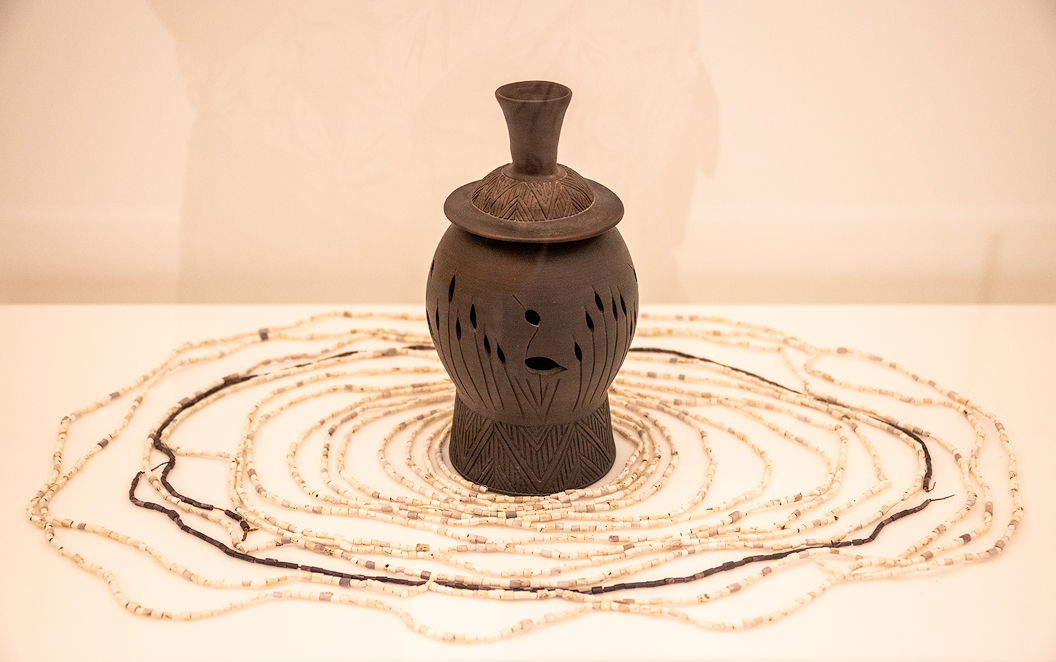
Waterbird vessel with lid, ca. 1980s, Darlene Smith, Mohawk, Ceramic
Heard Museum Collection
String of wampum beads, са. 1650-1665, Seneca, Quahoag shell
Rock Foundation Collection
String of wampum beads, ca. early 1600s, Haudenosaunee, Quahoag shell
Heard Museum Collection
(left)
Sky Woman, Joe Greene (Mohawk)
Soapstone
Rock Foundation Collection
(foreground)
Mother of Nations pipe, ca. 1650-65, Seneca
Clay
Rock Foundation Collection
(center)
Pottery patterning tool, ca. 1650-1665, Seneca
Antler
Rock Foundation Collection
(right)
Clay cooking vessel, ca. 1650-65, Seneca, Earthenware
Rock Foundation Collection, 11/177
Clay pots represent the continuity of tradition and family, and the caretaking of matrilineal
knowledge. The locations of Seneca villages largely depended upon the decisions of elder
women, who knew from experience if a place contained adequate clays for making pots, as
they were responsible for the supply of food. The knowledge of clay, pottery making, which
wood would make good fire and the firing itself was passed down through the matrilineal line,
communicated only through women. This insured that the entire family was valued, and all
members could rely on each other for the communal support required to sustain the village.
The humble pottery was central to ceremonial life — it holds ceremonial food heated over fires at
the center of the Longhouse. The central fires represent spiritual life and the Nation itself, while
the clay pot within the fire represents the life of the people and their enjoyment of the Creator's
gifts on Turtle Island.

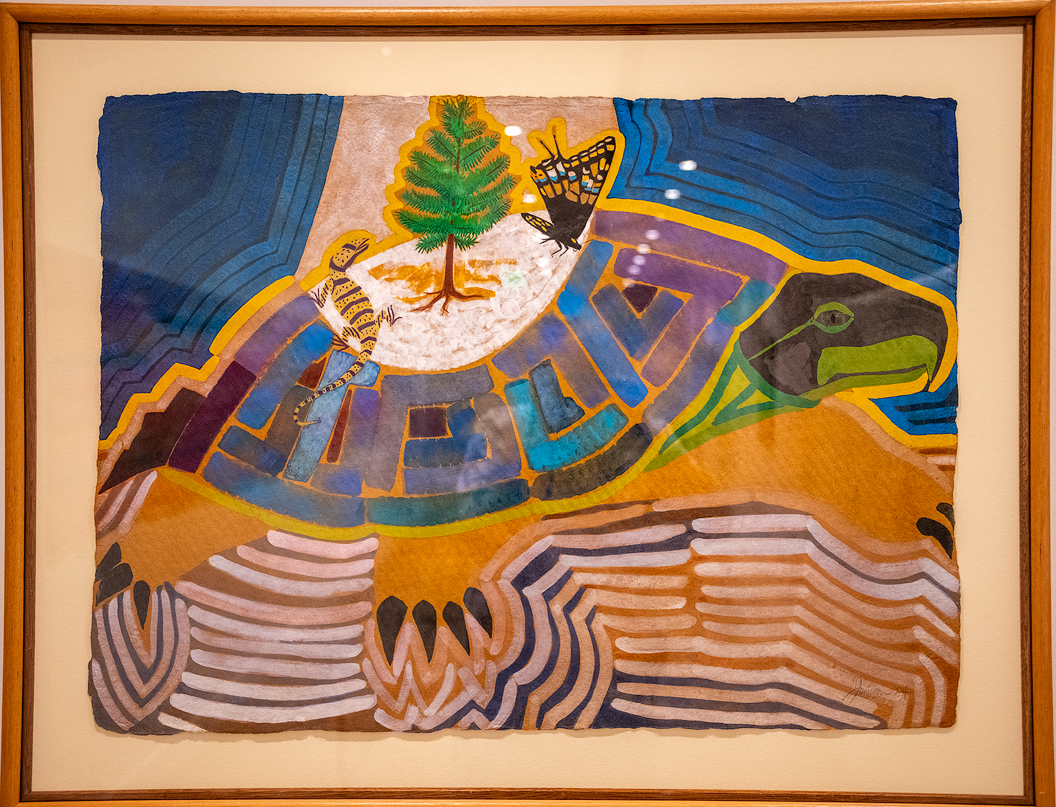
Balance Between Good and Evil, 1984,
G. Peter Jemison (Seneca, Snipe clan),
Mixed media on paper
Heard Museum Collection
This painting portrays Hanyadengona (the
Great Turtle), the foundation of the Earth in
Haudenosaunee knowledge. Celestial Tree, the
source of light in the Sky World, on his back
may reflect the concept of Orenda, the spiritual
force that flows through all things. It is flanked
by a lizard and a butterfly, which may symbolize
the twin creator brothers, Taöyawa'göh (Earth
Grasper) and Sawiskä: (Flint).
The Creator gave ceremonies that celebrate
agriculture, healing, and thanksgiving to balance
good with evil, and to honor the Karionake
(Celestial Beings), who inhabit the heavens
above the Sky Dome and the waters below
Hanyadengona. Radiating lines surround him,
indicating the presence of spiritual life. Jemison
may have used this kind of line, a traditional
Seneca design many centuries old, to suggest
genealogical harmony.
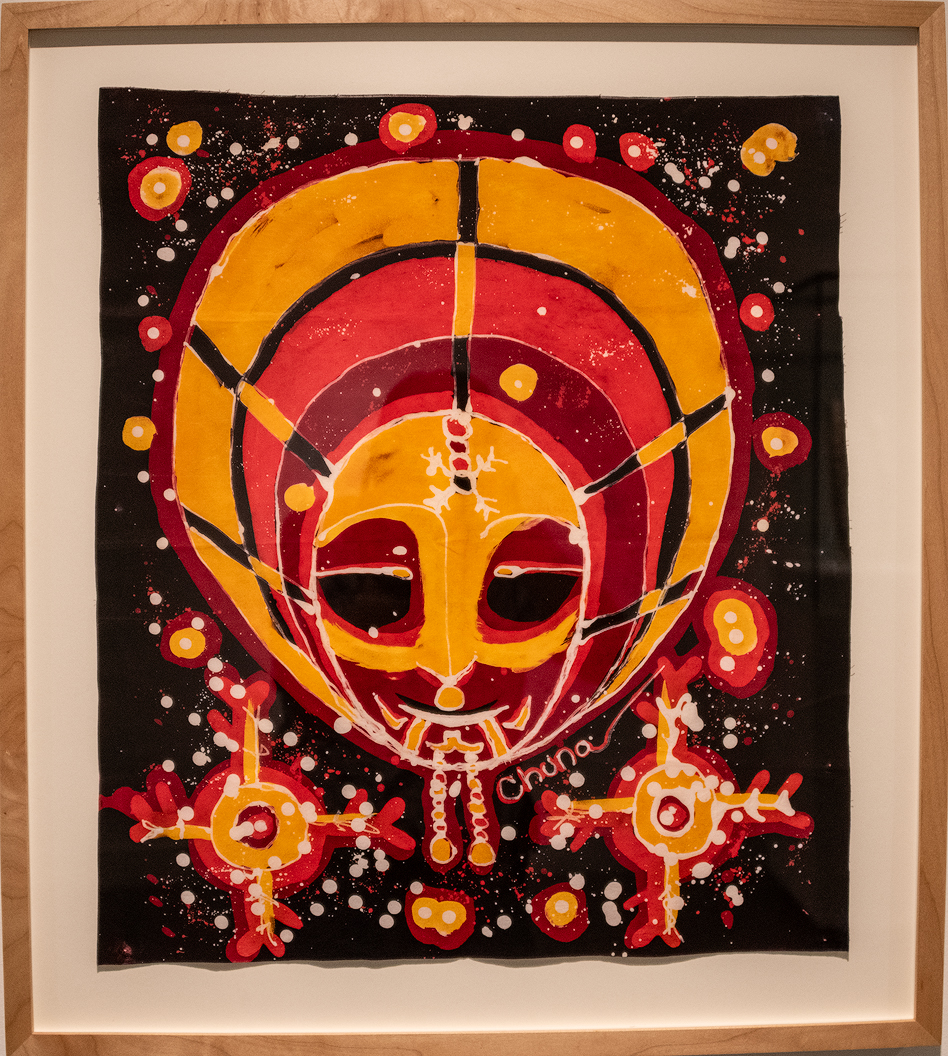
Ellam Yua, 1995,
Chuna McIntyre (Central Yup'ik), b. 1955,
Batik fabric
Private collection
This painting represents Ellam Yua, the human
manifestation of the spiritual universe. It contains
many of the ancient motifs seen throughout the
arts of Arctic and sub-Arctic cultures: its earrings
mimic the "circle-dot" design that indicates the
four cardinal directions, which are also eyes
and spiritual thresholds through which entities
pass. The mask-like yua face follows traditional
mask design, with concentric ellanguaq hoops
indicating knowledge and awareness of the outer
universe. Beyond them appears the stars and
the heavens. Labrets and forehead decorations
indicate wisdom and sacred knowledge.
I did not find an explanation of the items in this photo. However, the item on the left appears to be a canoe paddle, nicely crafted out of fine wood.
The item on the right appears to be a head covering to be used in the wintertime to ward off the cold winds.

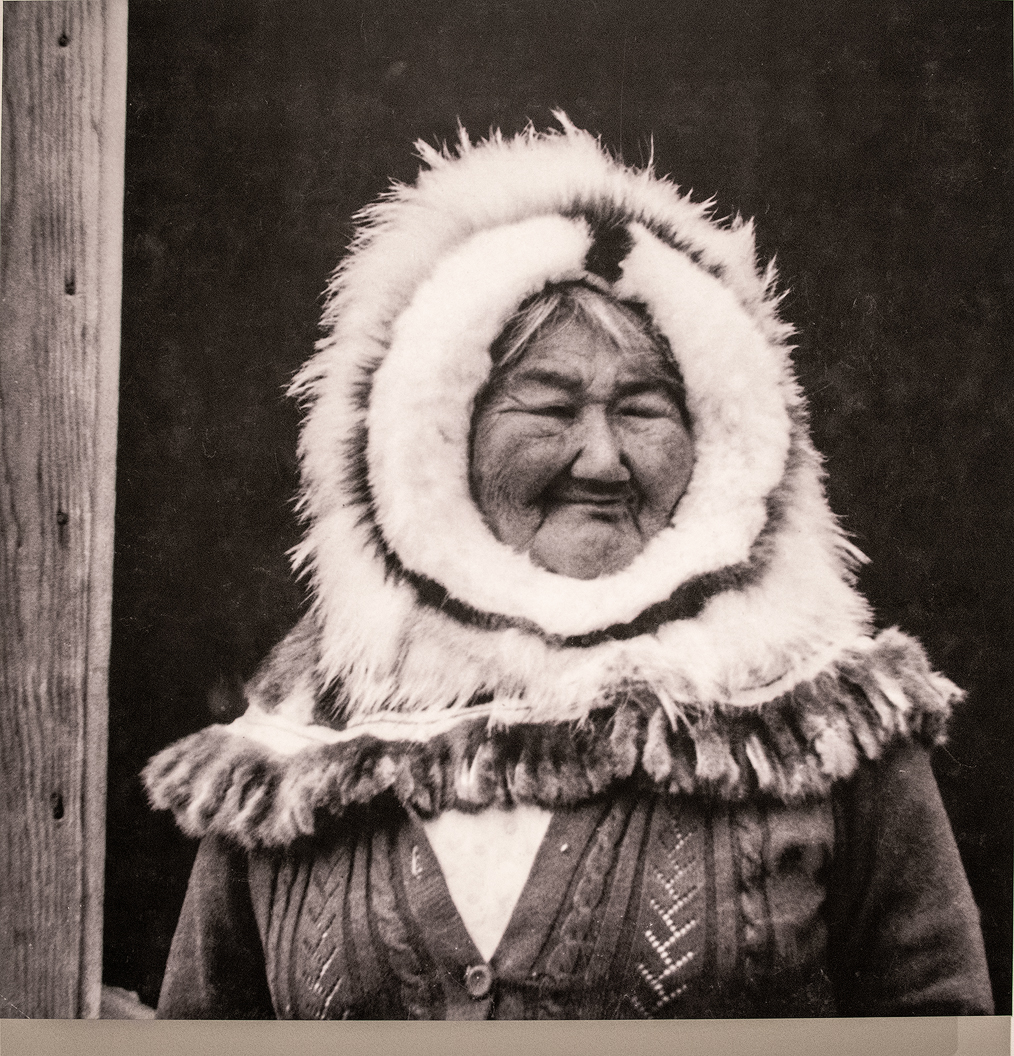
Photo by Chuna McIntyre, 1985, of his grandmother
at age eighty-five wearing a fur hood called a
yuraryaraq ("one you don on"). Her English name
was Minnie Carter and in Yup'ik she was named
Augilnguq ("bloodless one"), born in an ancient
place near the village of Quinhagak, Alaska.
The fur hood appears to be similar to the one in the previous photo.
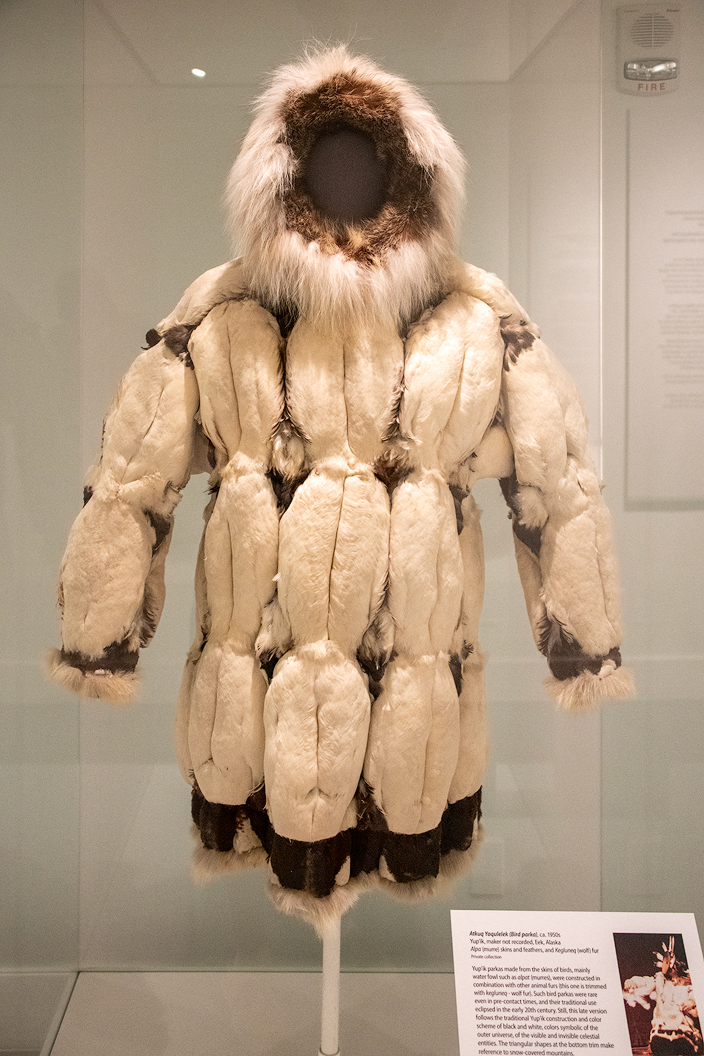
Atkug Yaqulelek (Bird parka), ca. 1950s,
Yup'ik, maker not recorded, Eek, Alaska
Alpa (murre) skins and feathers, and Kegluneq (wolf) fur
Private collection
Yup'ik parkas made from the skins of birds, mainly
water fowl such as alpat (murres), were constructed in
combination with other animal furs (this one is trimmed
with kegluneq — wolf fur). Such bird parkas were rare
even in pre-contact times, and their traditional use
eclipsed in the early 20th century. Still, this late version
follows the traditional Yup'ik construction and color
scheme of black and white, colors symbolic of the
outer universe, of the visible and invisible celestial
entities. The triangular shapes at the bottom trim make
reference to snow-covered mountains.