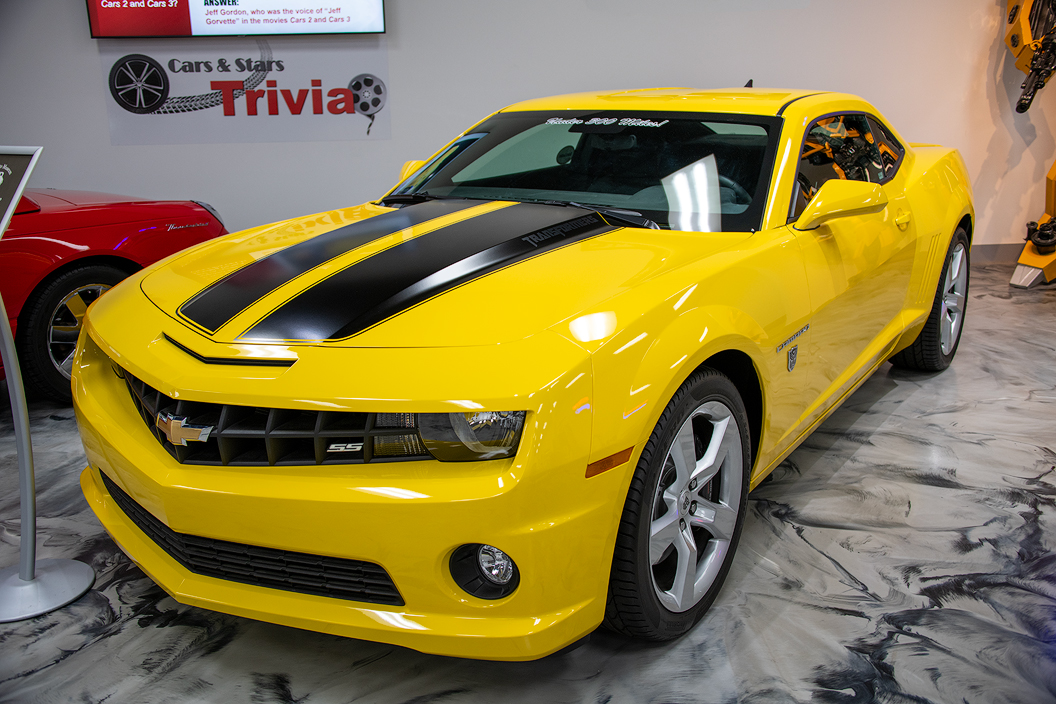
2010 Transformer Edition Chevrolet Camaro
At the 2009 San Diego Comic-Con, General Motors announced a partnership with Hasbro to offer a Transformers Special Edition appearance package for the 2010 Chevrolet Camaro (shown in this first photo). The special edition car was designed to resemble the Bumblebee Camaro from the 2007 hit movie. The package included:
- Autobot insignia fender badges and wheel caps
- An embroidered Autobot insignia on the center console
- Gloss-black rally stripes with Transformers logos
- Transformers-logo doorsill plates.
Upon acquiring the car, the Martin Auto Museum reached out to a sculpture artist in Los Angeles to build the "life-size" Bumblebee Transformer sculpture displayed below. The sculpture took months to build and is constructed of hundreds of car parts and pieces of scrap metal.

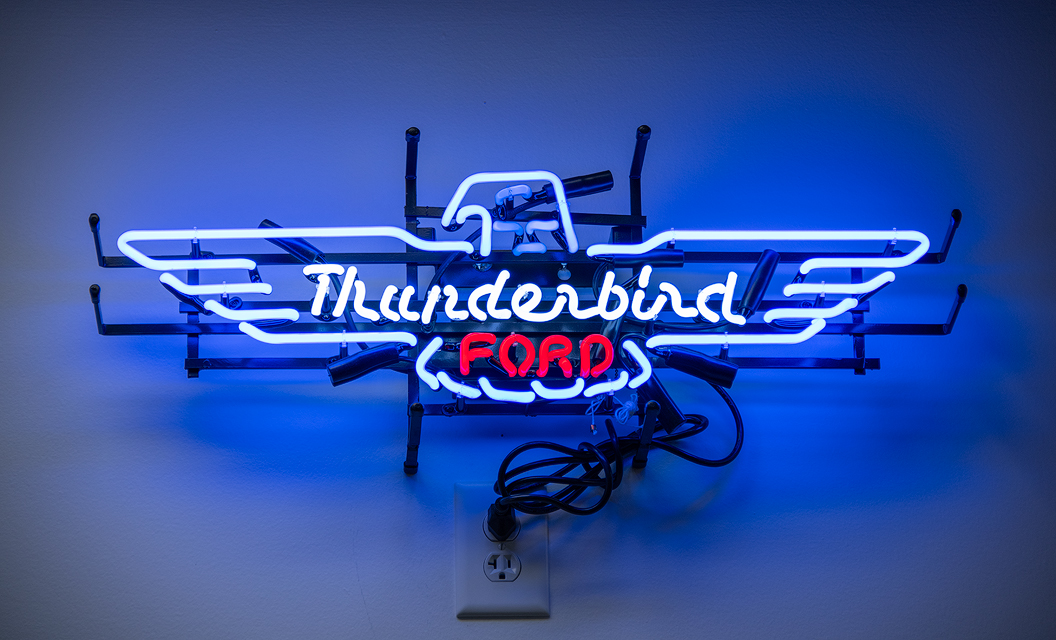
The Ford Thunderbird is one of the most well-known and loved personal luxury cars AKA sports cars ever produced. The logo (depicted here in neon) is one of the most recognized automobile symbols in the industry.
The Ford Thunderbird — also known as a T-Bird — is a personal luxury car produced by Ford from model years 1955 until 1997 and 2002 until 2005 across 11 distinct generations. Introduced as a two-seat convertible, the Thunderbird was produced in various body configurations. These included a four-seat hardtop coupe, four-seat convertible, five-seat convertible and hardtop, four-door pillared hardtop sedan, six-passenger hardtop coupe, and five-passenger pillared coupe, with the final generation designed again as a two-seat convertible.

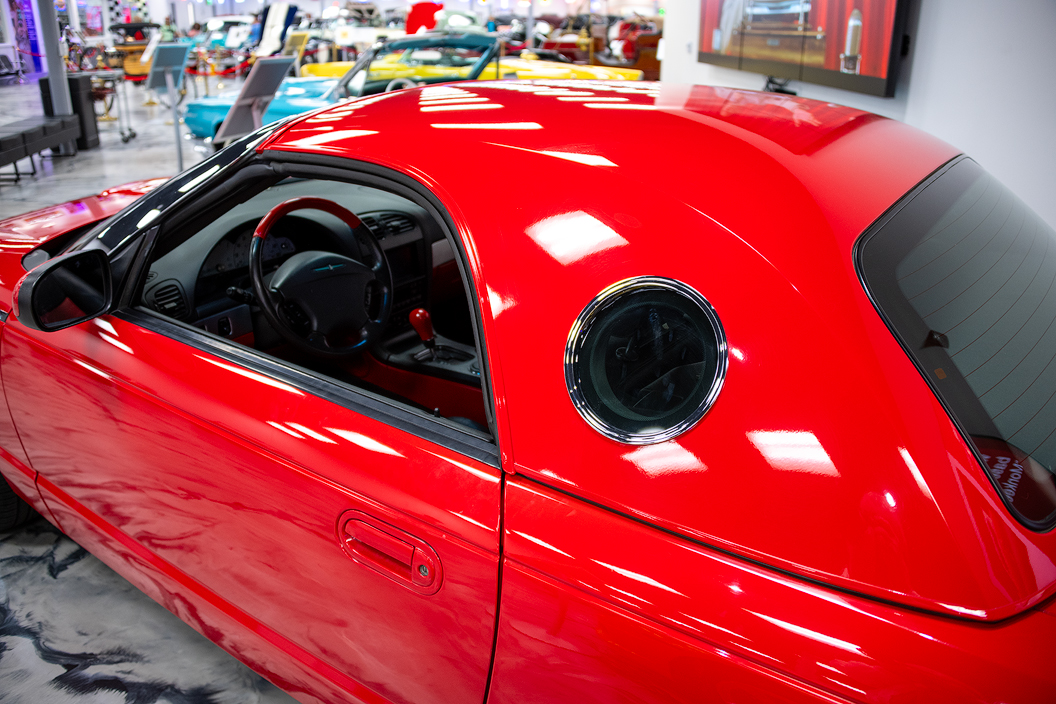
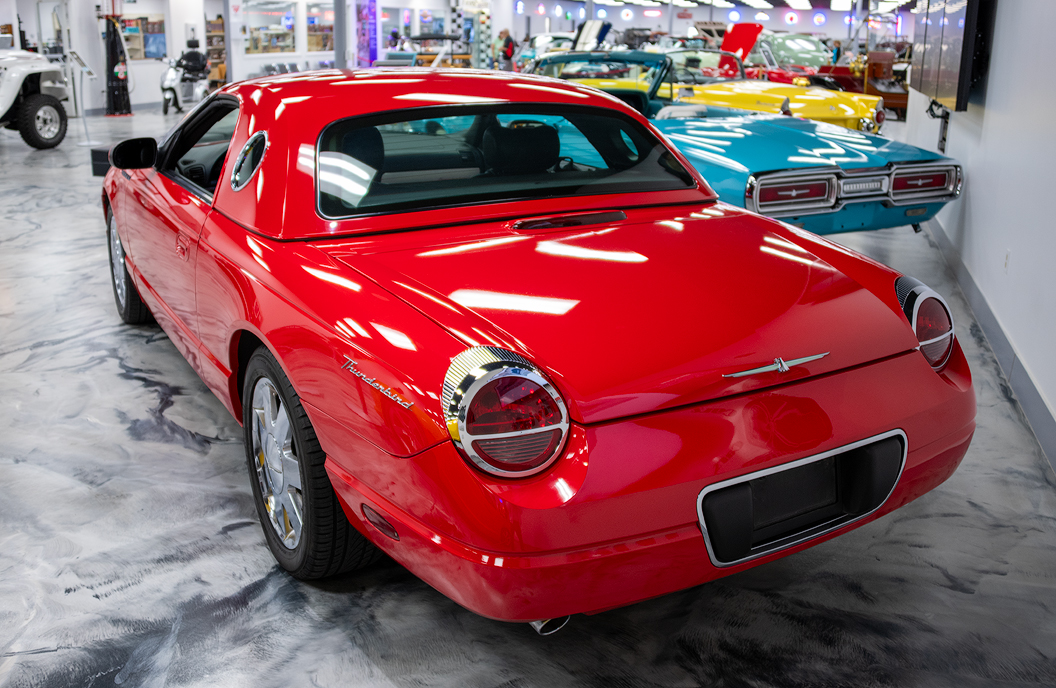
After a five-year hiatus between 1997 and 1992, Ford introduced the 2002 Thunderbird. Returning to the original formula for the Thunderbird, the latest version had a two-passenger convertible/removable hardtop configuration like the first-generation Thunderbird and styling strongly recalling the original.
Note the circular window in this removable hardtop — kids my age said it was "So Cool!" It still is!
Though the Thunderbird's exterior styling was unique relative to the others, the instrument panel, steering wheel, and other trim pieces were borrowed from the Lincoln LS. The sole engine of the Thunderbird was a Jaguar-designed AJ-30 3.9-liter V-8, a short-stroke variant of the Jaguar AJ-26 4.0-liter V8.
With sales dropping significantly after the 2002 model year, Ford ended Thunderbird production with the 2005 model year. The last Thunderbird was manufactured on July 1, 2005.
1964 Ford Thunderbird Convertible
Initially, Ford's Thunderbird was built to battle the Corvette for American two-seat supremacy when it arrived in 1955 — although it was not marketed as a sports car. After three years, the Thunderbird abandoned the competition with the Corvette and moved to a design that was even more focused on personal luxury.
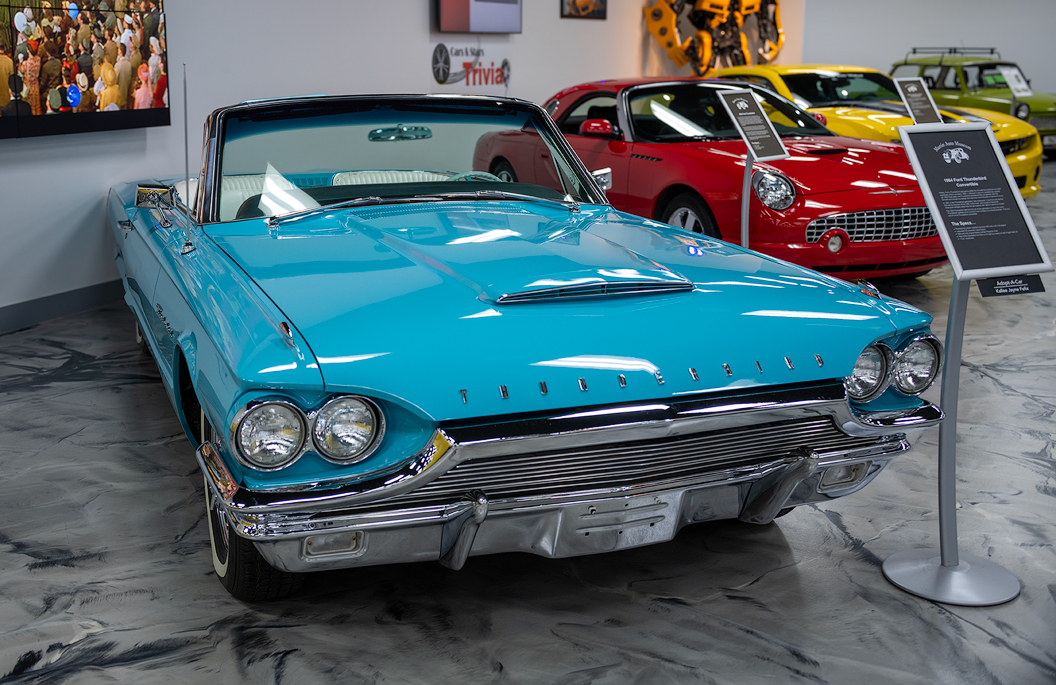
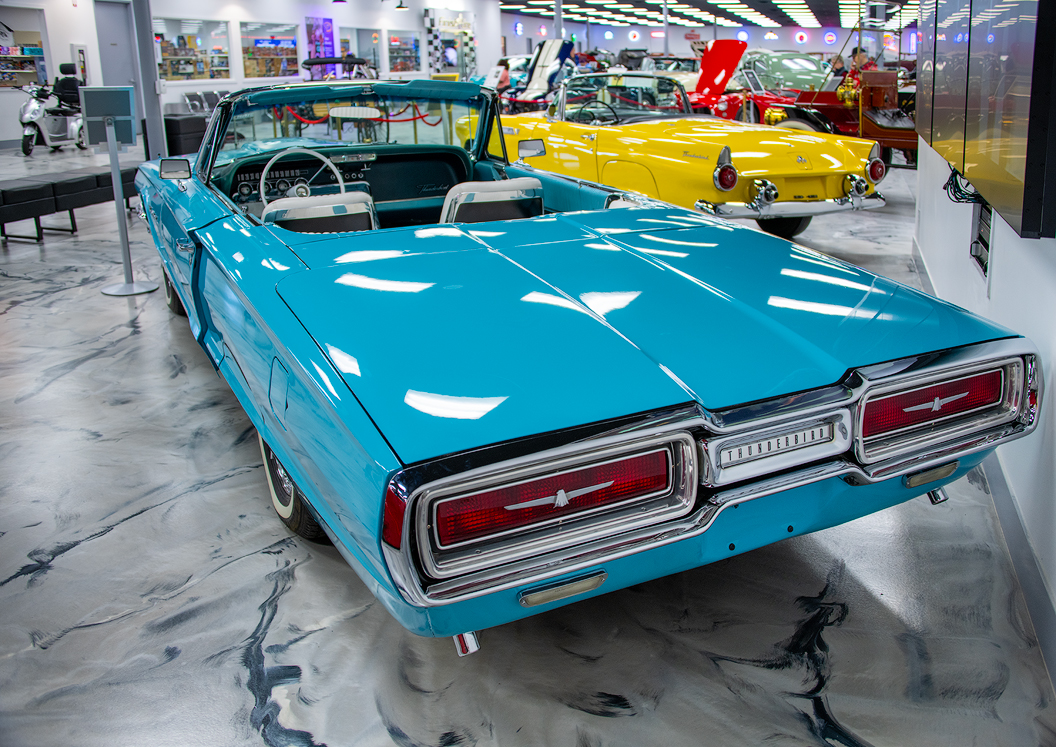
In 1964, a new Thunderbird generation was introduced. It has front-end styling that was an evolution of the 1963 "bullet nose" and moved to horizontal rectangular taillights rather than the jet-inspired rear lights in previous models. The 1964 Thunderbird was the only car of this generation to have the word "Thunderbird" spelled out on the front hood instead of a chrome emblem. This is a one-of-a-kind Thunderbird convertible.
1955 Ford Thunderbird
Ford unveiled the Thunderbird at the Detroit Auto Show in February 1954. The first production car came off the line in September 1954 and went on sale the next month as a 1955 model. Sales were brisk, with 3,500 orders placed in the first ten days. While only 10,000 were planned, 16,155 cars were ultimately sold in 1955.
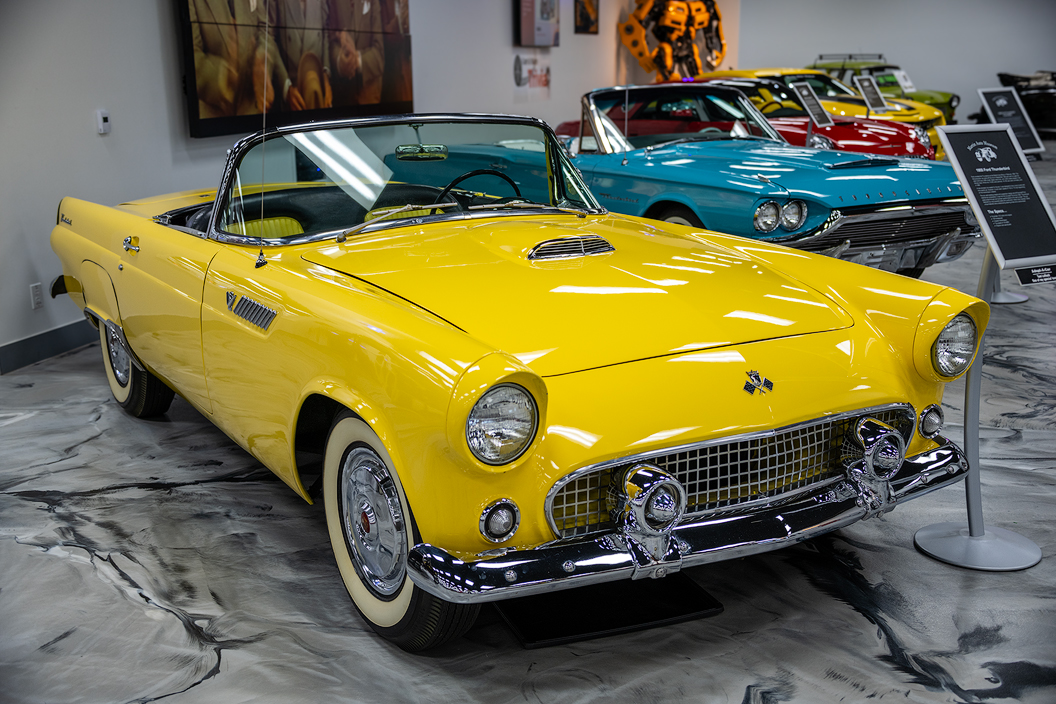
A rare domestic two-seater for the era, it was designed to be a luxury tourer and not a sports car. However, it could reach 100 to 115 mph speeds depending on the transmission ordered.
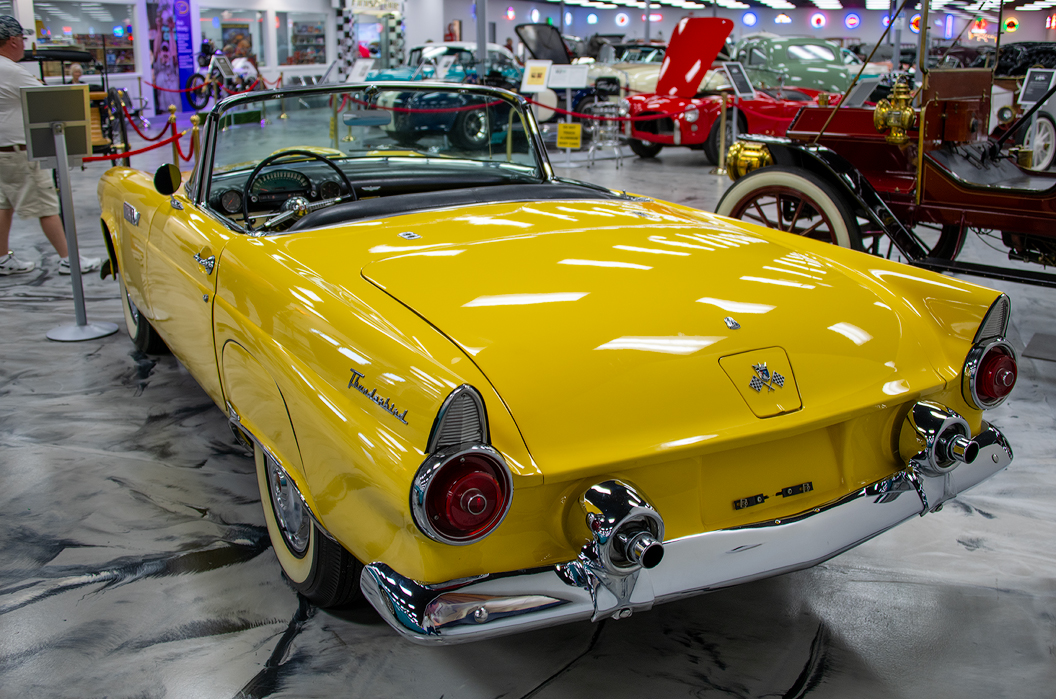
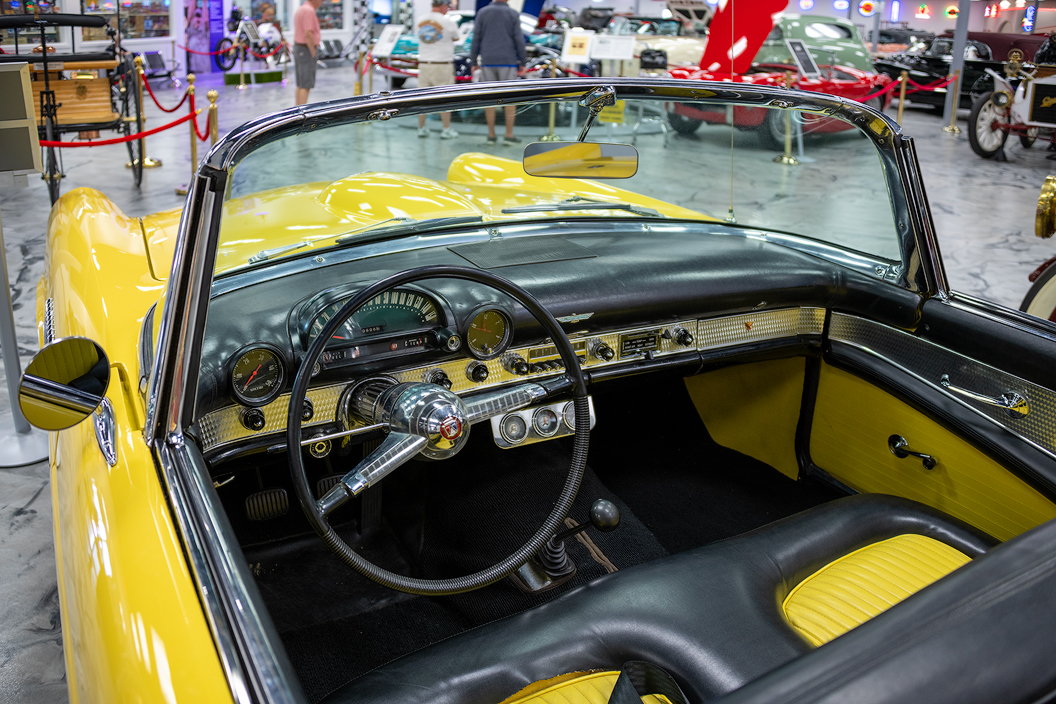
The car used existing chassis and suspension design and off-the-shelf Ford mechanical components. It was the first two-seat Ford since 1938. The exhaust pipes exited through twin bumper guards bolted to the rear bumper. The car featured four-way powered seats and pushbutton interior door handles. Other unique features were a telescoping steering wheel and a tachometer.
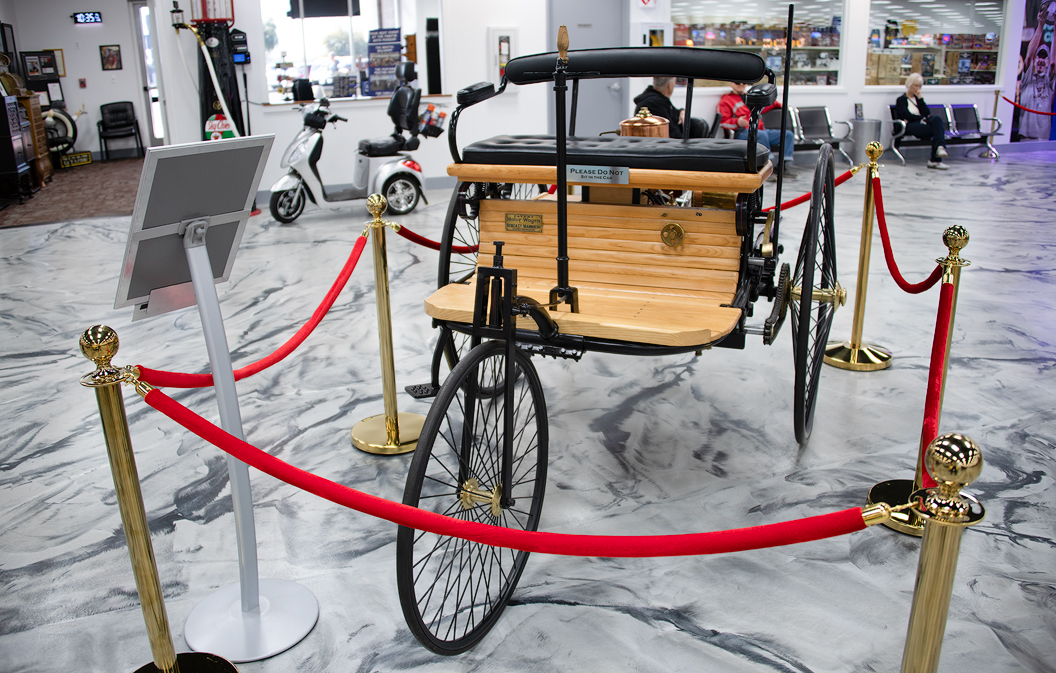
1886 Benz Motorwagen (Replica)
The Benz Patent-Motorwagen (built in 1885), is widely regarded as the world's first piston-powered production automobile. On January 29, 1886, Karl Benz patented the three-wheeled Patent-Motorwagen (patent number 37435). Later in the same year, just 60 miles away, Gottlieb Daimler patented an internal combustion engine and began with the construction of a four-wheeled horseless carriage. Neither Benz nor Daimler were aware of the other's work.
Karl's wife Bertha Benz, whose dowry financed their enterprise, knew the need for publicity. She took the Patent-Motorwagen No. 3 and drove it on the first long-distance internal combustion automobile road trip to demonstrate its feasibility. She took her sons, Eugen and Richard, fifteen and fourteen years old, on the 121-mile trip in August 1888. As well as being the driver, Benz acted as a mechanic on the drive, cleaning the carburetor with her hat pin and using a garter KAISERLICHES TALENTAME to insulate wires. She refueled at a local pharmacy along the route, taking on ligroin as fuel, making it the first filling station in history. As the brakes wore down, Benz asked a local shoemaker to nail leather on the brake blocks, thus inventing brake linings.
In commemoration of the 100th anniversary of the Benz Patent-Motorwagen, Mercedes-Benz produced a series of fully functioning replicas of this vehicle, mainly for dealer exhibits.

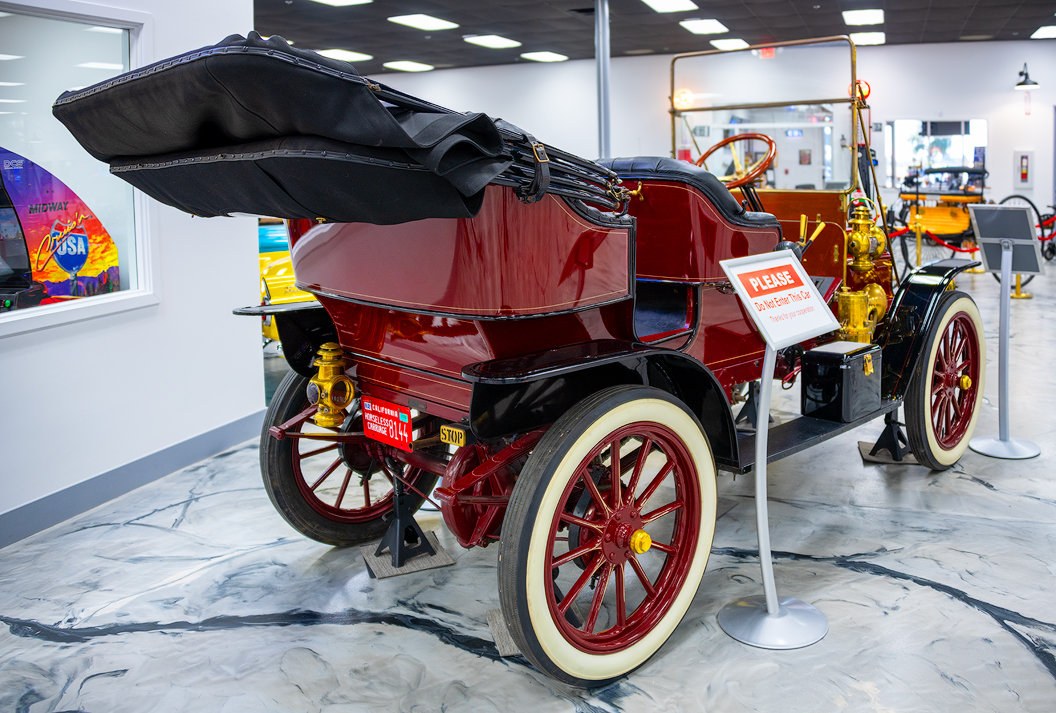
1909 REO Five-Passenger Touring Car
REO was an American automotive manufacturer founded in 1905. Named for its founder, Ransom E. Olds, REO created a wide range of trucks and cars during the company's history. REO is most well-known for its Royale and Flying Cloud models, but it also produced a wide array of trucks and buses. By 1907, REO had gross sales of $4.5 million, and the company was one of the four wealthiest automobile manufacturers in the U.S.

After 1908, despite the introduction of improved cars designed by Olds, REO's share of the automobile market decreased due in part to competition from emerging companies like Ford and General Motors. REO was purchased by the White Motor Company and merged with Diamond T Trucks to create Diamond REO Trucks in 1967 — ending the REO brand.

Perhaps the most historical REO event was the 1912 Trans-Canada journey. Traveling 4,176 miles from Halifax, Nova Scotia, to Vancouver, British Columbia, in a 1912 REO special touring car, mechanic/driver Fonce V. (Jack) Haney and journalist Thomas W. Wilby made the first trip by automobile across Canada (including one short jaunt into northeastern Washington state when the Canadian roads were virtually impassable).
This 1909 REO Five-Passenger Touring Carisa running and fully operational vehicle and an excellent example of the brand.