I was lucky to learn of the Martin Auto Museum located in north central Phoenix. I immediately grabbed my camera and headed out expecting to capture a couple dozen photos but to my surprise, the museum has a collection of approximately 180 showroom-ready vehicles of all ages.
I recognized that this was a serious collection when the first car I spotted was a 1957 Chevy in a beautiful turquoise blue. I have long thought that this model was the epitome of automotive design.
I hope you enjoy this trip through automotive history as much as I did capturing it with my camera.

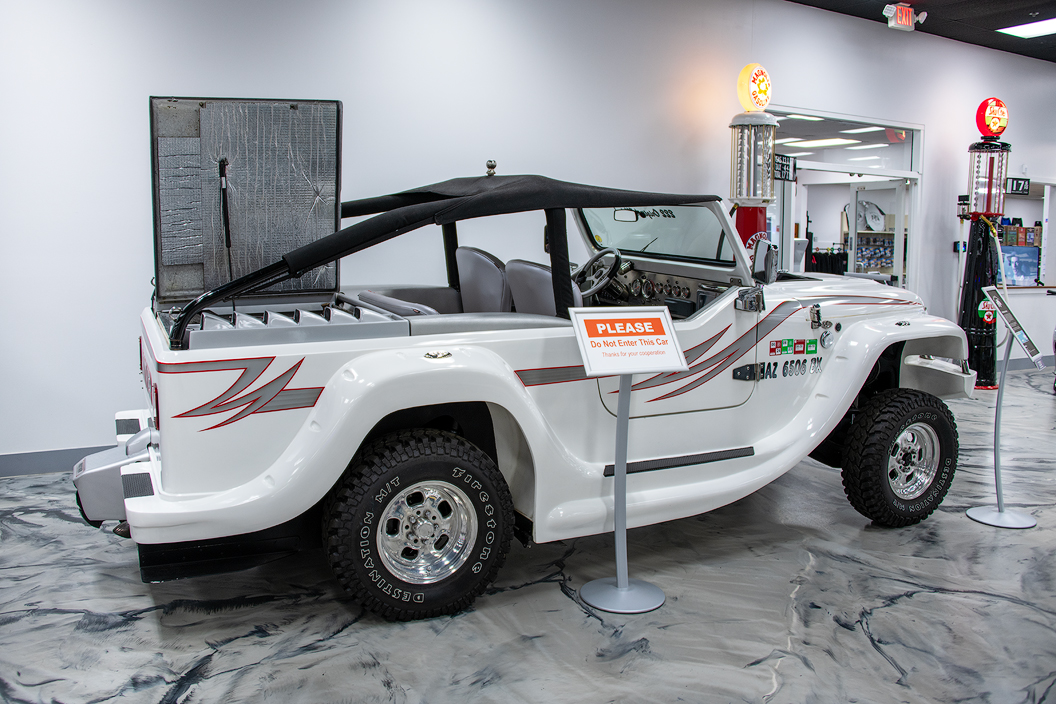
In 2014, a WaterCar Panther was featured in ABC's reality television series The Bachelor. The WaterCar has also been featured in USA Network's television series Royal Pains and an episode of Jay Leno's Garage.
But these 80-inch wheelbase wonders did have two things going for them. The first was the low entry price of $325 for a convertible coupe and $350 for a convertible sedan. Second was the fuel economy these lightweight runabouts provided. Crosley claimed that they were capable of 50 miles per gallon, but 40 miles per gallon was more realistic. Crosley's dreams of selling 50,000 of the cute cars through department stores and the dealer network for his other appliances was a bit optimistic. They ended up selling 1,200 cars in 1939. Combined production from 1940 through 1942 added up to around 5,000 cars.

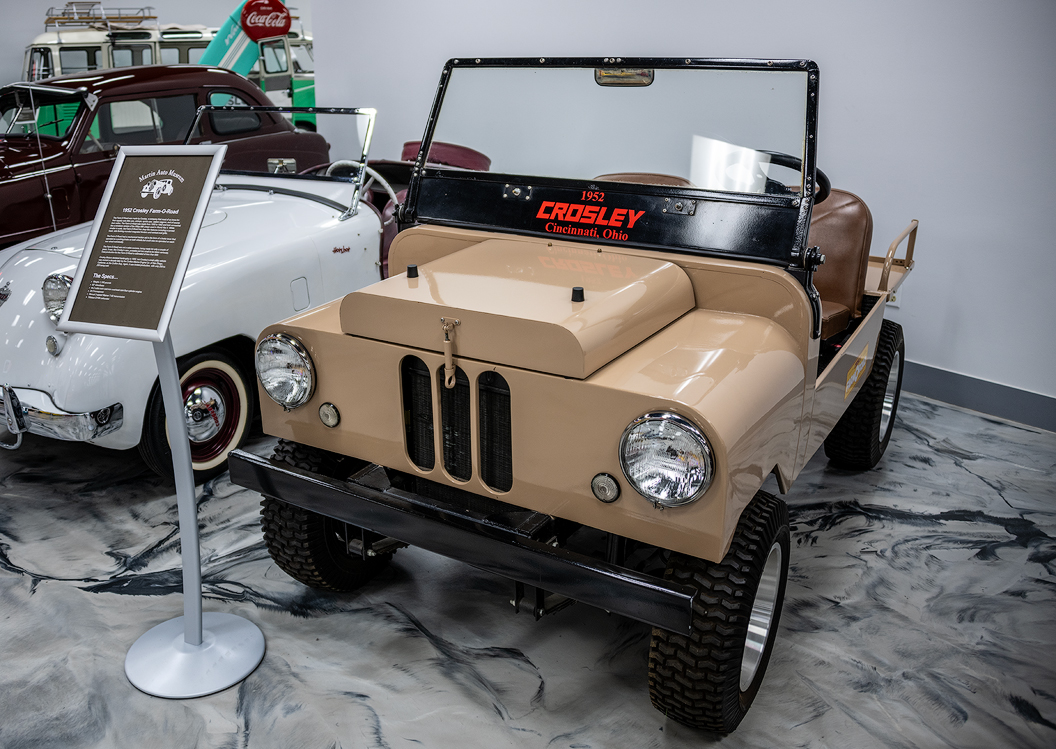
The Farm-O-Road had a mechanical traction aid in the form of a brake lever that operated as a parking brake on both wheels but could also be operated on each rear wheel individually. The Farm-O-Road was not a sales success, being made for only a couple of years. It was, like Crosley's cars, probably just too small to be taken seriously. Total production for the Farm-O-Road is estimated at less than 600. Crosley Motors declared bankruptcy in 1952, but Crosley's small utility vehicle was revived a decade laterby the Crofton Marine Engine Co. of San Diego, California, as the Crofton Bug. Again, it saw limited production, with only 200 to 250 being sold.

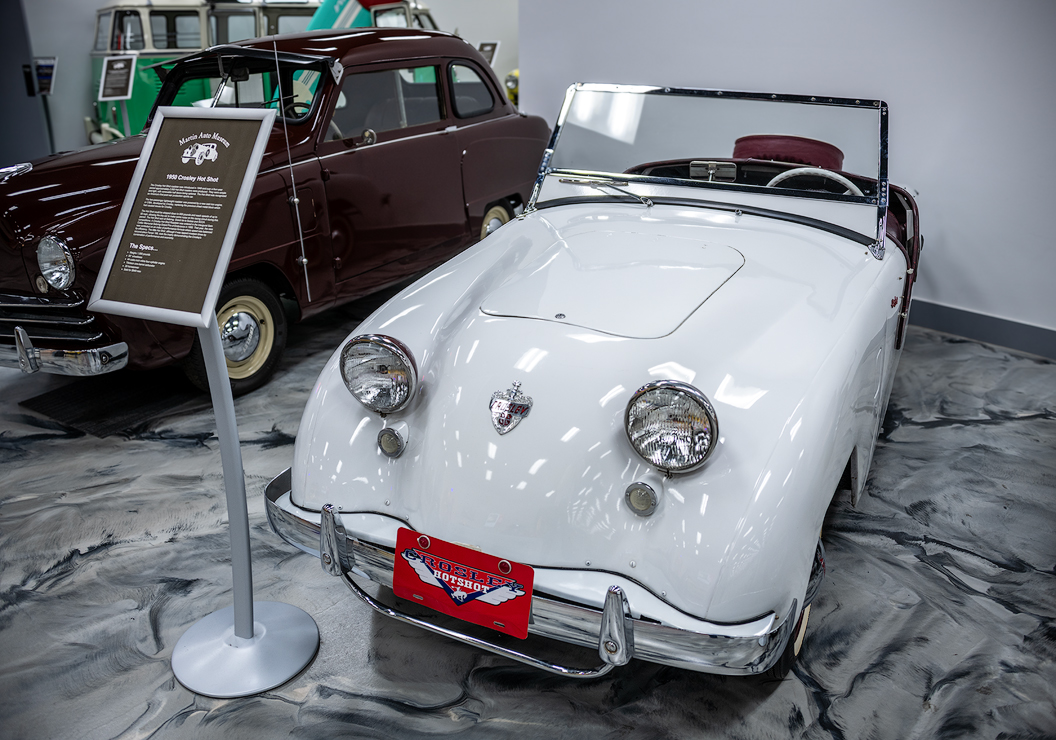
The Crosley Hot Shot roadster was introduced in 1949 and over a four-year period approximately 2,500 Hot Shot roasters were produced. They were simple and light, with removable half doors being optional. The Hot Shot was recognized as America's first post-war production sports car. The two-passenger lightweight roadster was powered by a new cast iron engine, or CIBA, developed by Crosley, replacing the previous sheet metal block which had caused issues for Crosley.
The Hot Shot could be stripped down to 900 pounds and reach speeds of up to 90 mph, allowing the tiny car to make some noise on the racing circuit during this period. The Hot Shot won at Sebring, Grand de la Suisse and SCCA competitions. A Crosley Hot Shot Roadster was entered in the inaugural Sam Collier Memorial Sebring Grand Prix of Endurance in 1950. That year, the race was contested on an index of performance formula where speed was balanced by efficiency. The little Hot Shot, although it was lapped nineteen times by second-place Ferrari 166, took the trophy demonstrating the Crosley's combination of performance and economy.
Crosley had a number of firsts in automotive history, including:
- First affordable, mass-market car with an overhead cam shaft engine in 1946;
- First use of the term "sport utility" vehicle in 1947, for a 1948 model year convertible wagon;
- First American cars to be fitted with 4-wheel caliper type disc brakes; and
- America's first post-war sports car, the Hotshot, in the 1949 model year.
All of Crosley's models were lightweight (1,100 to 1,400 pounds) body-on-frame cars with rigid axles front and rear, and engines with less than 61 cubic inches of displacement. The vast majority of all Crosleys were built on an 80-inch wheelbase and with leaf-springs.

Even though Crosley was shipping an all-new body and a new engine, most of the rest of the chassis and brakes were left over from pre-war production.
These little cars were well built but underpowered even in their day. The 44 cubic-inch engine was a novel design first used during World War II to power generators for the US Navy. Called the CoBra for the novel copper brazing method of steel stampings to create the upper block. The bottom end was cast aluminum. The little engine performed beyond expectations in the wartime generators but use in automobiles proved troublesome. Galvanatic action between the dissimilar metals and the corrosive effects of the antifreezes of the time lead to pre-mature failures. Crosley switched to a cast iron block in 1949, and you will find this block under the hood of nearly all running Crosleys today, including this one.

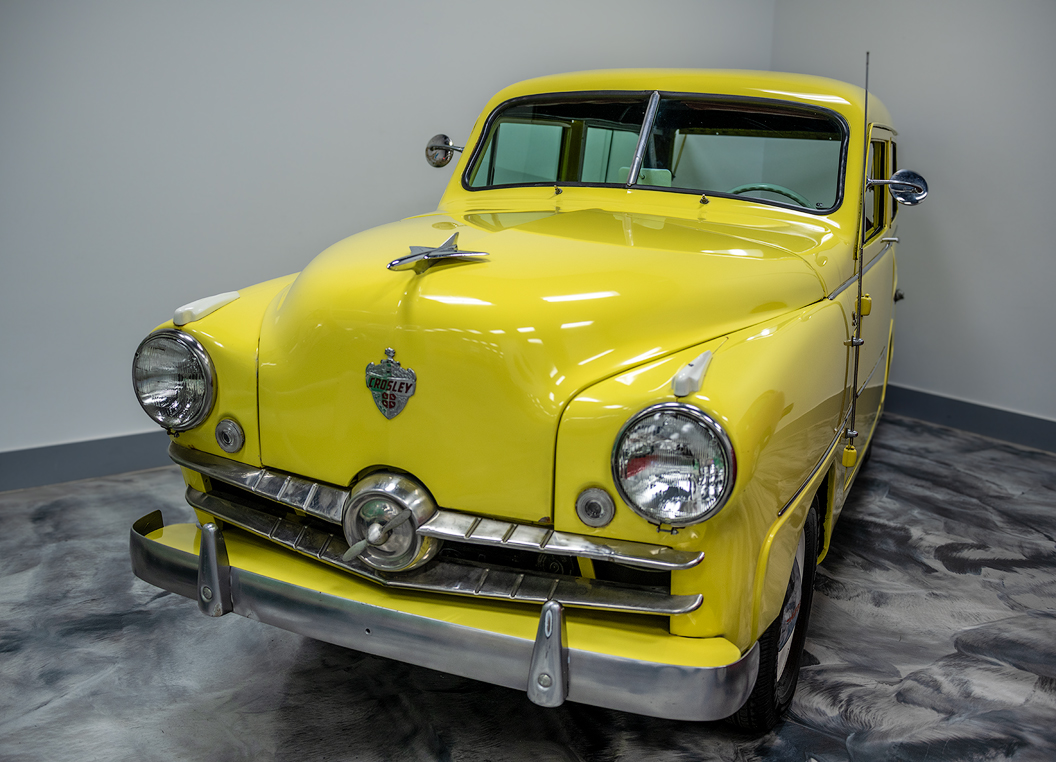
In the post-war period, station wagons had emerged as a growing market segment and Crosley produced the first Super Wagon in 1949. The stylish wagon could be ordered with two-toned interiors, chrome trim, and optional features — winning the hearts and frugal wallets of many cost-conscious middle-class suburbanites. Between 1949 and 1952, the Super Wagon was Crosley's top selling model.
23-Window Conversion
This Volkswagen began as a 1973 Volkswagen Type 215-window Bus built in Brazil. It was refurbished in 2021 and converted to a "Samba-style" bus in Brazil before being imported to the US in January 2022.
Volkswagen do Brazil was established when the Brazilian government banned the import of fully built vehicles in 1953. Their factory was erected in 1958 and started production of the Kombi bus. There were several versions produced by Volkswagen do Brazil over the next 56 years, including 11, 13 and 15-window models. This bus started as a 15-window model and was later modified to replicate the Samba Deluxe (built from 1955-1958) — adding a sliding cloth sunroof and eight windows on the roof line.
The extra windows of the original 23-window Volkswagen Deluxe Microbus model allowed relatively unobstructed views of passing scenery. As a result, the bus was often used for tourist transport and was known by the nicknames Samba Bus or AlpsBus.
Brazil had the last factory in the world that produced the T2 series of Type 2 , which ceased production in December 2014 due to the introduction of more stringent safety regulations in Brazil. This marked the end of the era of rear-engine Volkswagens, which had originated in 1935 with their Type 1 prototypes.

The Volkswagen Beetle is a two-door, rear-engine economy car, intended for five occupants but was restricted to four people in some countries. The Beetle was known by many names — it was officially the Volkswagen Type 1. Informally in German, it was der Käfer (meaning "beetle"). In parts of the English-speaking world it was known as the Bug and by many other nicknames in other languages.

The Volkswagen Beetle's origin began as Hitler's "people car" and would go on to become an all-time bestseller and a cult classic. The Beetle was manufactured and marketed by German automaker Volkswagen (VW) from 1938 until 2003. The Beetle is the longest-running and most-manufactured car of a single design platform anywhere in the world.
I bought a VW Beetle as my first car (hardtop, not a convertible) after I graduated from college and began working. It was a great little car for someone living in Minnesota because of the engine being located over the rear drive wheels. That configuration provided excellent traction on the Twin City's snowy roads. Also it was very cheap to operate — cheap gas, cheap servicing, and cheap repairs.
