OMG!!! Another Desert Rose — and even bigger than the previous one!!! This one is taller than me!!!
Well, my curiosity cannot be ignored. I turned to Wikipedia and found the following —
"Adenium obesum, more commonly known as a desert rose, is a poisonous species of
flowering plant belonging to the tribe Nerieae of the subfamily Apocynoideae
of the dogbane family, Apocynaceae. It is native to the Sahel regions south of
the Sahara (from Mauritania and Senegal to Sudan), tropical and subtropical
eastern and southern Africa, as well as the Arabian Peninsula.
Other names for the flower include Sabi star, kudu, mock azalea, and impala lily.
Adenium obesum is a popular houseplant and bonsai in temperate regions."
Note that the article contained a couple of photos of huge Adenium obesum growing in the wild. Amazing!!!

This plant looks familiar — we have them in Lowe's Garden. This herbaceous succulent is also referred to as Portulacaria afra, elephant food, elephant plant, dwarf jade, miniature jade, or small leaf jade, porkbush, spekboom, and others. Most often, it is grown as a seasonal accent plant or houseplant — however, note that they may grow as large as 20 feet tall!!!

This tree is one of my favorites in the Garden — a Boojum Tree which surprisingly is in the Ocotillo family. It is native to the Baja California Peninsula in Mexico. The plant's English name, Boojum, was given by Godfrey Sykes of the Desert Laboratory in Tucson, Arizona, and is taken from Lewis Carroll's poem "The Hunting of the Snark".
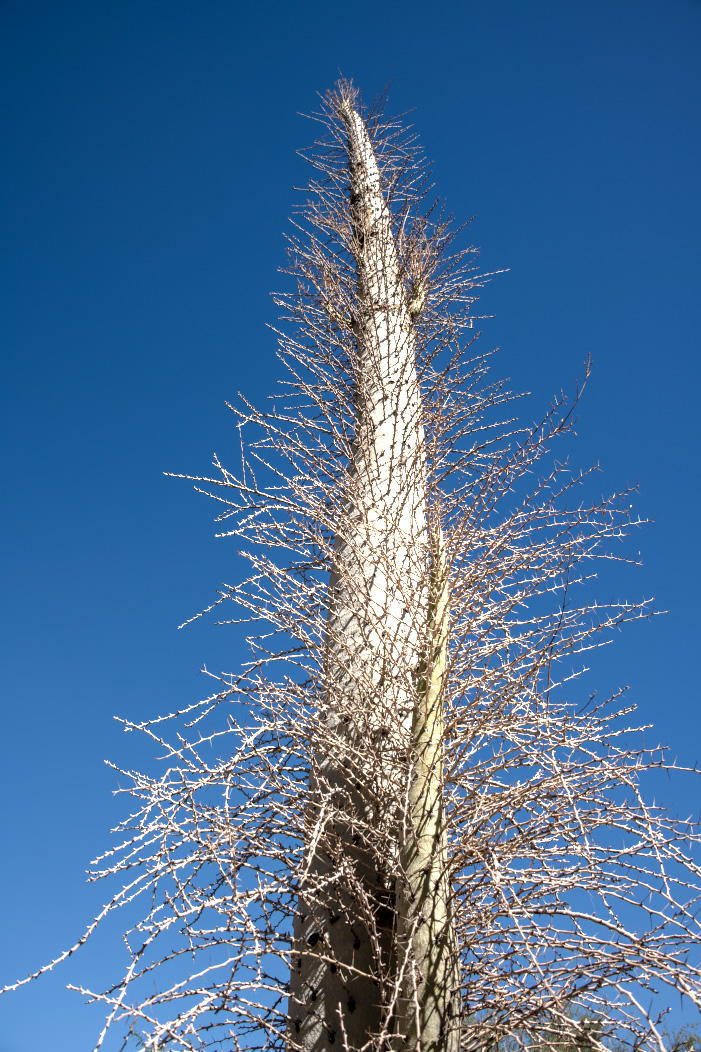
Here is a juvenile Boojum Tree just outside the shaded pavilion. These trees have no major branches but
with numerous thin, twiggy branches sticking out at right angles, all covered with small leaves
1.5–4 cm (0.59–1.57 in) long. They can grow to a height of 20 meters (almost 70 feet).
It is among the slowest growing trees — even at fifty years of age, it may be only five feet (1.5 meters) tall,
and thereafter averages twelve inches (thirty centimeters) every ten years.

I was surprised to see this area where the Garden is being expanded. These Texas Sage plants provide a bit of a barrier between the established Garden area and the new space.

Turning around, a movement caught my eye. There it is right in the middle, facing away from the camera. I listened but did not hear the cartoon call of "meep, meep". Can you see it?
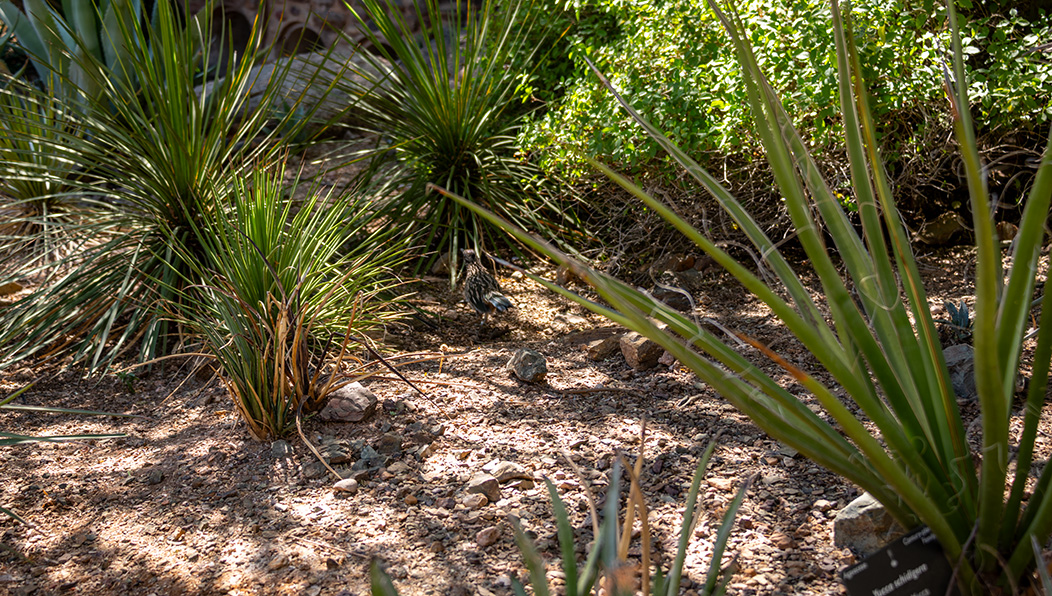
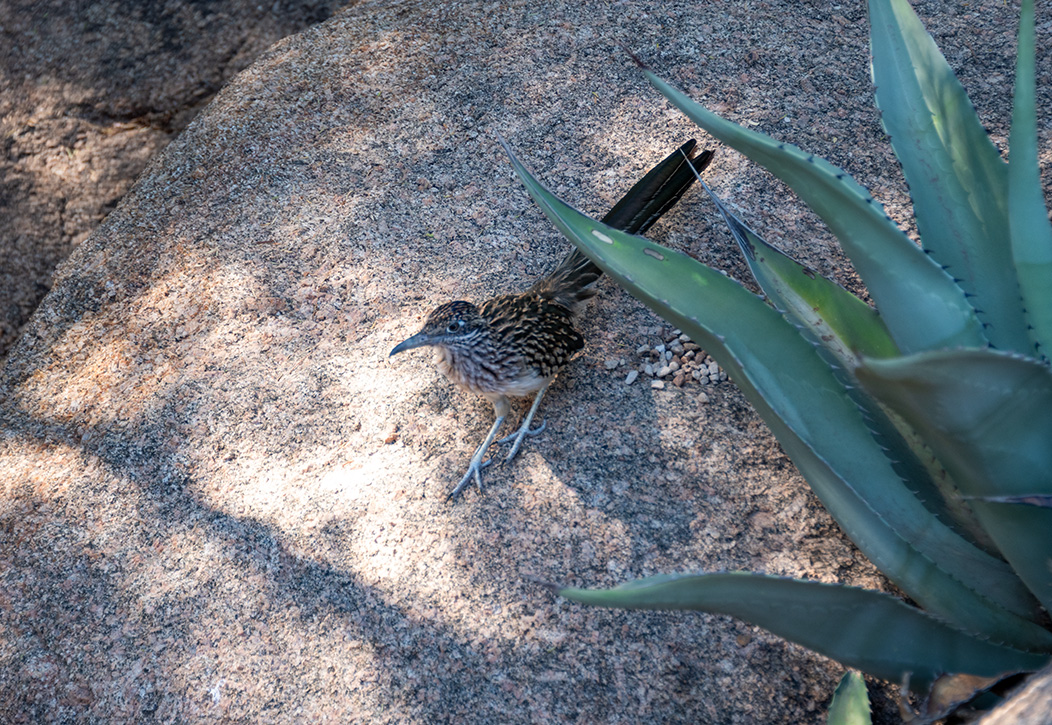
I remained as still as possible, and the Roadrunner came toward me — so I was able to get a decent photo. A moment later, it scampered away in case Wiley Coyote was nearby.
Next, I encountered an abstract sculpture totally different than the featured geometric figures I have already shared. Interesting.

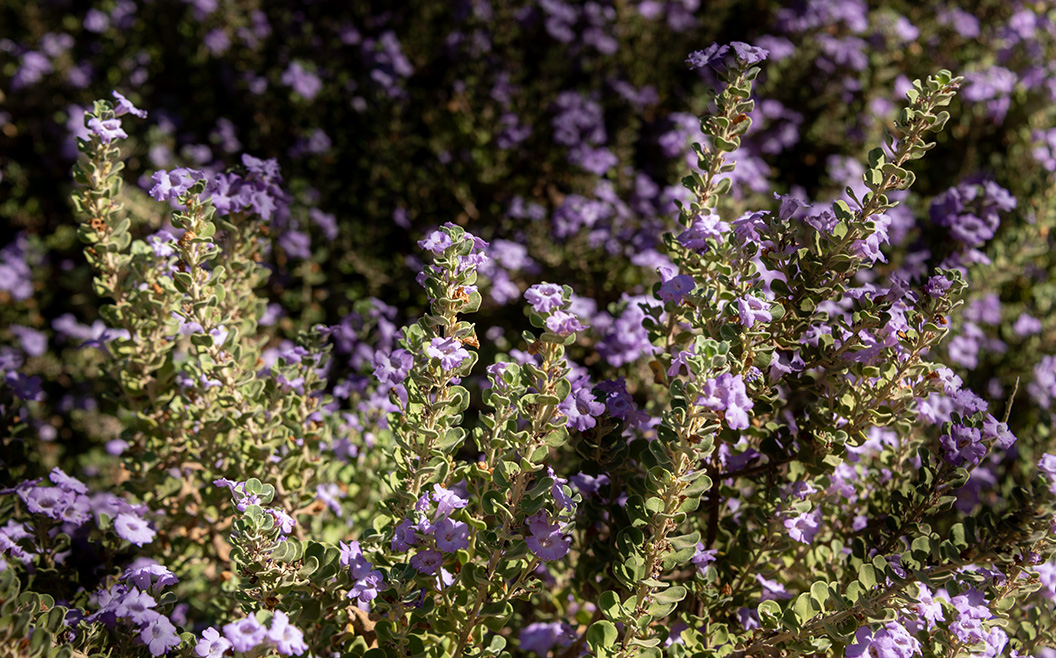
Oh, another patch of Texas Sage. This is a plant that is used extensively by the Arizona Highway Department. It tolerates our HOT, HOT Arizona sun and only needs a bit of water to decorate our highways year-round.
Opuntia, commonly called the prickly pear cactus, is a genus of flowering plants in the cactus family Cactaceae, many known for their
flavorful fruit and showy flowers.
The fruit of prickly pears, commonly called cactus fruit, cactus fig, Indian fig (meaning "Native American", not "of India"), nopales
or tuna in Spanish, is edible, although it must be peeled carefully to remove the small spines on the outer skin before consumption.
If the outer layer is not properly removed, glochids can be ingested, causing discomfort of the throat, lips, and tongue,
as the small spines are easily lodged in the skin. Native Americans like the Tequesta would roll the fruit around in a suitable
medium (e.g. grit) to "sand" off the glochids. Alternatively, rotating the fruit in the flame of a campfire or torch
has been used to remove the glochids. Today, parthenocarpic (seedless) cultivars are also available. The seeds can be used for flour.
In Mexico, prickly pears are often used to make appetizers, soups, salads, entrees, vegetable dishes, breads, desserts, beverages,
candy, jelly, and drinks. The young stem segments, usually called pads or nopales, are also edible in most species of Opuntia.
They are commonly used in Mexican cuisine in dishes such as huevos con nopales (eggs with nopal), or tacos de nopales.
Nopales are also an important ingredient in New Mexican cuisine. In 2009 it was introduced as a cheaper alternative to corn
for the production of tortillas and other corn products. They can also be pickled.

I stood next to a saguaro cactus just to see how big the thing was. They can be huge (this one was). But getting that close to a saguaro gave me a better appreciation for its areoles — the spikes that protect the plant from hungry animals. Survival of the fittest!

And here is that majestic saguaro!
