Aloha Festival, Part 3
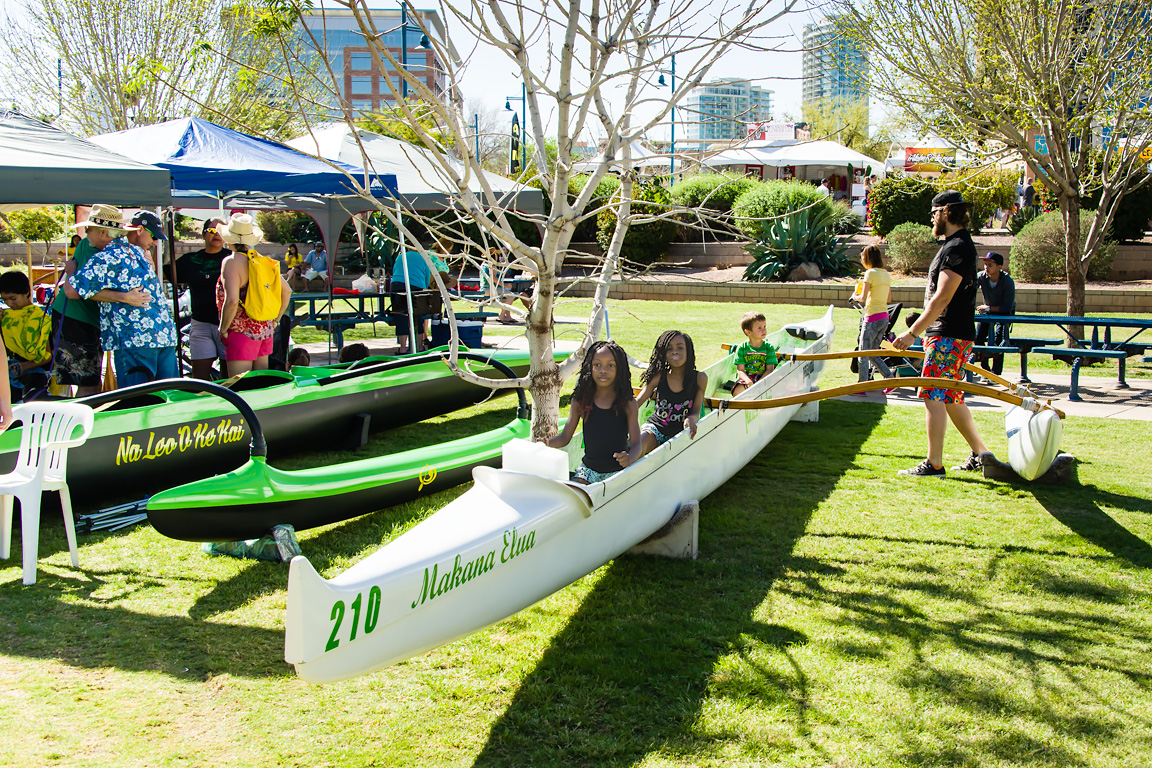
The kids seem to be enjoying their dry-land sailing in an outrigger canoe. This one, like most contemporary canoes, is made of modern materials such as fiberglass and laminated wood but follows traditional Hawaiian design. Nearby Town Lake is the site for many races — a fact surprising to most folks — that land-locked Tempe, in the middle of a desert, would be the locale for a vigorous outrigger canoe society.
 Nearby a booth was set up with traditional Hawaiian games. I am not familiar with this one but the kids sure seemed to be enjoying themselves.
 Another booth was sharing crafts with the keikis. So nice to see the sponsors organize activities for the kids — too often they are bored out of their minds at events like this.
 More booths with items for sale — anyone need a muumuu? They have them in lots of fabric patterns and sizes.
 Hats for sale. Some of them look like the cowboy hats worn by paniolos (cowboys of Hawai‘i) — the others, not so readily identified with the islands.
 Bracelets galore — colorful with a wide range of designs. They did not resemble the traditional Hawaiian Heirloom jewelry but I'll bet they were more affordable.
 Ah, kukui nut leis — these were painted with colorful designs. I found a nice description of the significance of the Kukui tree and its nuts on Wikipedia.
"In ancient Hawaiʻi, kukui nuts were burned to provide light. The nuts were strung in a row on a palm leaf midrib, lit one end, and burned one by one every 15 minutes or so. This led to their use as a measure of time. One could instruct someone to return home before the second nut burned out. Hawaiians also extracted the oil from the nut and burned it in a stone oil lamp called a kukui hele po (light, darkness goes) with a wick made of kapa cloth.
Hawaiians also had many other uses for the tree, including: leis from the shells, leaves and flowers; ink for tattoos from charred nuts; a varnish with the oil; and fishermen would chew the nuts and spit them on the water to break the surface tension and remove reflections, giving them greater underwater visibility. A red-brown dye made from the inner bark was used on kapa and aho (Touchardia latifolia cordage). A coating of kukui oil helped preserve ʻupena (fishing nets). The nohona waʻa (seats), pale (gunwales) of waʻa (outrigger canoes) were made from the wood. The trunk was sometimes used to make smaller canoes used for fishing. Kukui was named the state tree of Hawaii on 1 May 1959 due to its multitude of uses. It also represents the island of Molokaʻi, whose symbolic color is the silvery green of the kukui leaf."
 Hawai‘i, land of aloha. Even baseball caps proudly proclaim that fact.
 If you happen to see some of the oldest etchings created by the first European artists in the voyages of discovery, you will see some showing natives wearing helmets made of gourds, often decorated with feathers. The originals were called Makaki'i or Makini. Today most folks just call them warrior helmets.
These smaller versions were made from small coconut shells with dyed feathers. In Hawai‘i you will often see them hanging from vehicle rear-view mirrors or over home doorways. Not only are they decorative but many believe them to bring safety and protection.
 This tent was called the Ukulele Corner and provided basic instruction in how to play a ukulele. I loved the fact that they were teaching not just performing. Cool!
 More on the ukulele from Wikipedia —
"The ukulele is commonly associated with music from Hawaii where the name roughly translates as 'jumping flea', perhaps because of the movement of the player's fingers. Legend attributes it to the nickname of the Englishman Edward William Purvis, one of King Kalākaua's officers, because of his small size, fidgety manner, and playing expertise. According to Queen Liliʻuokalani, the last Hawaiian monarch, the name means 'the gift that came here', from the Hawaiian words uku (gift or reward) and lele (to come).
Developed in the 1880s, the ukulele is based on several small guitar-like instruments of Portuguese origin, the machete, the cavaquinho and the rajão, introduced to the Hawaiian Islands by Portuguese immigrants from Madeira and Cape Verde. Three immigrants in particular, Madeiran cabinet makers Manuel Nunes, José do Espírito Santo, and Augusto Dias, are generally credited as the first ukulele makers. Two weeks after they disembarked from the SS Ravenscrag in late August 1879, the Hawaiian Gazette reported that 'Madeira Islanders recently arrived here, have been delighting the people with nightly street concerts.'
One of the most important factors in establishing the ukulele in Hawaiian music and culture was the ardent support and promotion of the instrument by King Kalākaua. A patron of the arts, he incorporated it into performances at royal gatherings."
 We close our visit to the Aloha Festival with a display of signs reminding visitors to your home to remove their shoes (or sandals) before entering. This tradition came from Japanese immigrants — removing one's shoes upon entering a home is an absolute requirement in Japan.
The Japanese consider the soles of the shoes to be dirty and they wish to keep the inside of the house as clean as possible.
We close our visit to the Aloha Festival with a display of signs reminding visitors to your home to remove their shoes (or sandals) before entering. This tradition came from Japanese immigrants — removing one's shoes upon entering a home is an absolute requirement in Japan.
The Japanese consider the soles of the shoes to be dirty and they wish to keep the inside of the house as clean as possible.
Although this tradition at first may have seemed weird to non-Japanese residents of Hawai‘i, the practice eventually caught on with people of all ethnic backgrounds. It is common to see a large collection of shoes and, particularly, flip-flops lined up on the porch outside a residence — it means they are having a dinner or party and the guests have arrived. When the guests depart they reclaim their own footwear, usually. Occasionally, mistakes do occur and someone walks off in someone else's flip-flops — no worries, just pick another pair of the right size and call it even.
BTW, we have a ceramic sign outside our townhouse asking guests to remove their shoes. We even have surgical booties for workers who (they claim) cannot remove their shoes due to company regulations. I am the original owner of the property, purchased in 1996. The original carpets are in really good shape even though they are almost 20 years old. I credit the Hawaiian and Japanese custom of removing shoes for keeping it so.