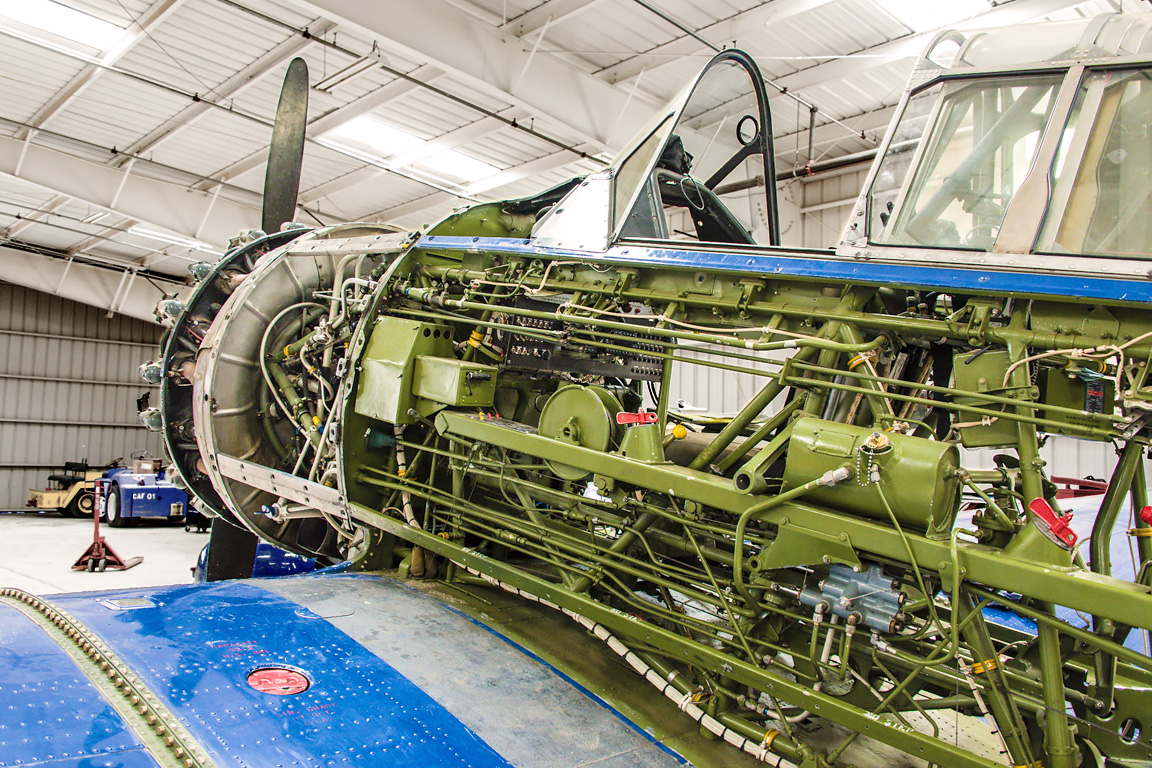
Commemorative Air Force, Arizona Wing, Part 7
We continue our tour with a Grumman AF-2S Guardian — which you can obviously see is being refurbished. Developed at the end of WWII, the Guardian served the U.S. Navy during the 1950s. It was a carrier-based anti-submarine warfare (ASW) aircraft that was produced in two variants working together as a hunter/killer team.

 The AF-2W version was the "hunter" carrying a large ventral radar to seek out targets from long distances. The AF-2S (on display here) was the "killer" equipped with up to 4,000 pounds of munitions including depth charges, bombs or a homing torpedo in its bomb bay, plus high-velocity rockets on under-wing pylons.
 Since the AF-2S and AF-2W were carrier-based, they were designed with folding wings in order to take up less space on an aircraft carrier. Seen from a distance, the folding wing looks like a toy airplane with hinged wings. Up close it is a lot more complex.
 I recalled that the first time I became aware of CAF, that the name stood for "Confederate Air Force". I later saw the name listed as "Commemorative Air Force". At the time, I was not sure if I had remembered the name incorrectly or if it had been changed. The following explanation is from Wikipedia.
'The original name, Confederate Air Force, started as a simple tongue in cheek type of joke, poking fun at their ragtag beginnings. As the collection of warbirds at Central Valley Airport in Mercedes, Texas started to grow, someone painted the name on the side of the original P-51 Mustang "Red Nose". The name stuck, and it grew to the point where the airport was renamed Rebel Field, all members were called "Colonels" (a tradition which still remains), and it led to the creation of a fictitious leader named Colonel Jethro E. Culpepper. There was even a humorous CAF twist put to the old AVG Flying Tigers WWII "blood chit" that read, “This foreign person has come to China to help in the war effort. Soldiers and civilians, one and all, should rescue, protect, and provide him medical care.” The CAF version seen on the backs of flight suits and flight jackets stated, "This is a CAF aviator. If found lost or unconscious, please hide him from Yankees, revive with mint julep and assist him in returning to friendly territory. CONFEDERATE AIR FORCE".'
'In 2002 it changed its name to Commemorative Air Force after a vote of the membership. Many felt the name Confederate Air Force was confusing, did not accurately reflect the purpose of the organization, and was detrimental to fundraising efforts. This name change was deemed by some fans to be a move of political correctness. The reason for the name change as stated by the organization was "Because the word 'Confederate' is offensive to some." '
 Next is an interesting little airplane — not what one thinks of when you say "warbird". There was no placard but some quick detective work showed me that it is a Champion 7EC built in 1956.
 Since this aircraft was built ten years after WWII was over, why is it a "warbird"? The clue is the logo of the "CAP Subchasers". Perhaps this aircraft did not see service during the war but the Subchasers did — patrolling coastal waters looking for enemy submarines. Once they spotted a sub, they could radio its coordinates for the Air Force or Navy to follow with real firepower.
The CAP evolved into the Civilian Air Patrol which is the civilian arm of the Air Force — assisting in search and rescue operations even today.
 And here is the pilot's view of the aircraft.
 I know this item does not look like it could fly but it is really the stinger on the bee — actually on a B-25J. The B-25 Mitchell is well-known and evolved to multiple models.
In the South Pacific, these planes were used to attack Japanese convoys both en-route but also in port. Unfortunately, the light armaments and medium altitude bombing tactics were ineffective.
Lt. Col Paul I. "Pappy" Gunn, Commander of the Fifth Air Force Service Command decided to "field modify" the B-25s, increasing their range, adding side blister guns and replacing the bombardier's position with a solid-nose gun platform as you see here. These mods were done against the advice of the manufacturer and the Army Material Command — but were so effective that the Air Force incorporated the design changes into new B-25s coming off the assembly line plus retrofitted existing aircraft.
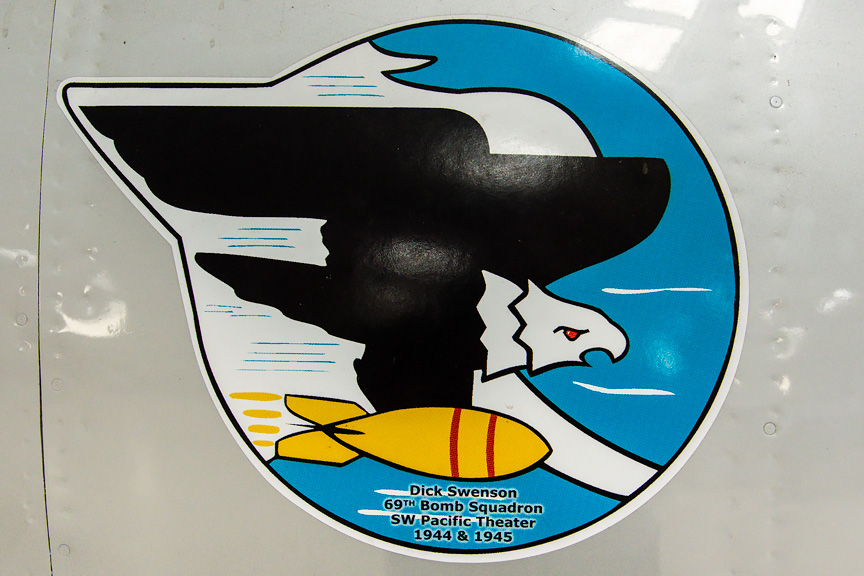 "Pappy" also developed the tactic of "skip bombing" — a simple but incredibly dangerous method of accurately attacking enemy ships. B-25s would approach at wave height, firing all guns. They would then drop their bombs and, like skipping rocks across a pond, they would skip to the target. Delay fuses would allow the bomb to strike the side of the ship then sink below the hull before exploding.
"Pappy's" innovations helped turn the tide of war in the Pacific.
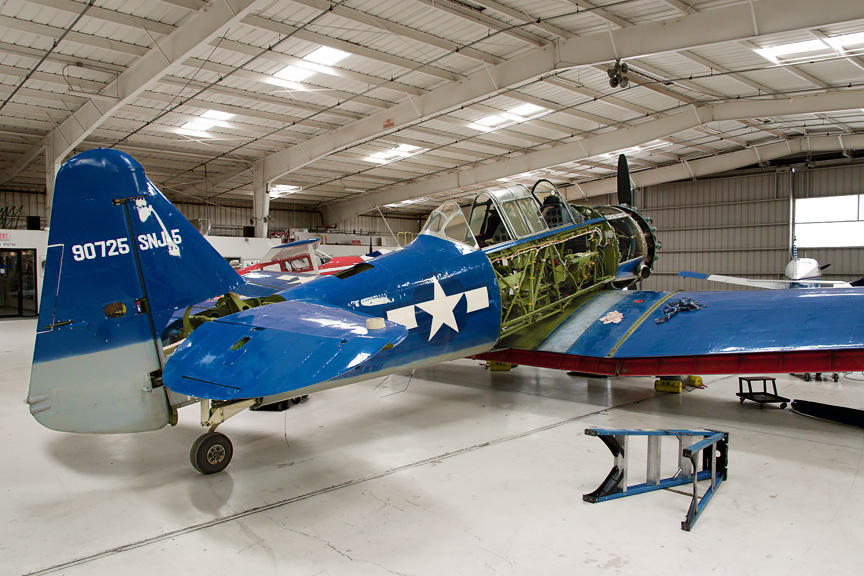 Now this is really interesting, a North American SNJ-5 "Texan" with the side panels of the fuselage removed for maintenance. Almost looks like an X-ray.
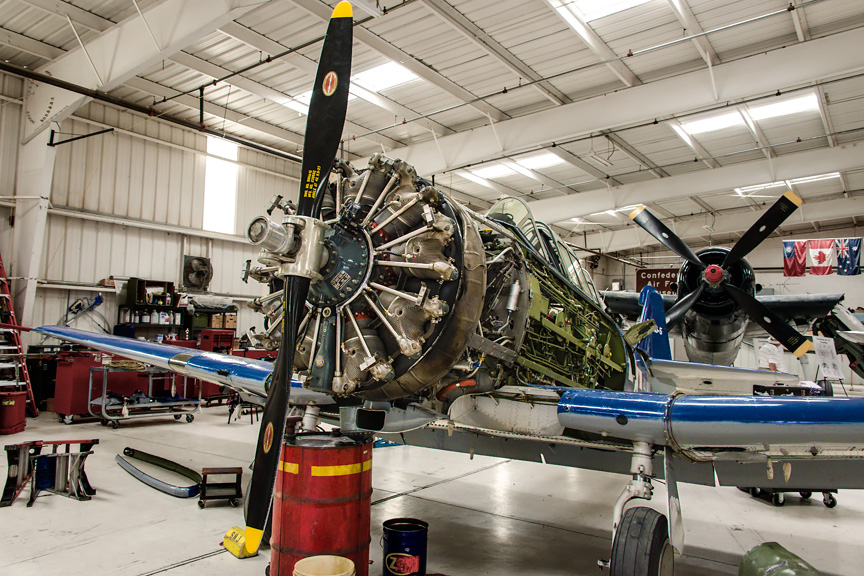 The SJN was the standard advanced trainer used by both the Navy and Air Force from 1938 through the 1950s. More than 50,000 US Army/Air Force pilots and 40,000 Navy pilots were trained in these planes — plus the many pilots in other nations.
Although retired from military service in the mid-50s, many "Texans" are still flying today as civilian sport and utility aircraft.